Texting to Prepaid Cells to Recruit Underrepresented Populations for Probability Panels
By Kevin Collins
One of the persistent challenges in probability-based survey research is that some groups of respondents are consistently more difficult to reach. Mail-based outreach to address-based samples (ABS), a standard approach to building probability panels, typically underrepresents several important groups, including younger adults, Hispanic respondents, Black respondents, those without a college degree, lower-income households, and people who did not vote in the most recent election, to name a few. These gaps are well-documented, and while post-survey weighting can help correct for them, weighting alone cannot solve problems that stem from who is and is not in the panel to begin with. The best solution is to recruit a more representative panel in the first place.
In this post, we describe a collaboration between Survey 160 and SSRS to test whether supplementing traditional mail-based recruitment with SMS outreach to prepaid cell phone numbers can bring harder-to-reach populations into a probability panel. The results, which we presented at the 2026 CIPHER conference, suggest that it can, and that the panelists recruited this way provide data of comparable quality to those recruited through conventional means.
To understand why prepaid cell phones are a useful sampling frame for this purpose, it helps to understand what distinguishes them from standard mobile plans. Most cell phone users in the United States are on “normal” plans: they sign a contract, often with a credit check, and pay their bill at the end of each month. Prepaid phones, by contrast, are non-contract plans that can be activated simply by purchasing a SIM card. Prepaid plans are more commonly used by individuals who cannot qualify for traditional contracts, whether due to credit history, immigration status, housing instability, or simply preference for flexibility. The prepaid market is substantial and growing. As of 2021, about one-third of US adults had a prepaid cellular plan. All of the major carriers operate in this space, often under brands. T-Mobile operates MintMobile, Verizon owns Tracfone and Straight Talk, and Boost Mobile, Cricket, and Consumer Cellular all run on the AT&T network. Prior research has found that including prepaid phone numbers in survey samples leads to more interviews with harder-to-survey populations, including Black adults, Hispanic adults, Spanish-language respondents, individuals with less than a high school diploma, lower income households, individuals covered by Medicaid, those rating their health as fair or poor, people living in urban areas, renters, those unregistered to vote, and political independents. Building on this evidence, SSRS worked with Survey 160 to add text message outreach to prepaid phone numbers as part of its SSRS Opinion Panel recruitment process in 2025, in order to reach this population more cost effectively.
The process is straightforward. Prepaid cell phone numbers are drawn from a sample vendor, with carrier data used to flag numbers as prepaid. Survey 160 screens each number through a phone validation service. An initial text message is then sent, identifying the sender as SSRS and inviting the recipient to participate in a short survey, with a $10 incentive offered for completion. Those who agree receive a branded link directing them to an online survey. At the end of the survey, respondents are invited to join the SSRS Opinion Panel for future research. The conversion funnel for this process narrows at predictable points. Approximately 98% of numbers pass the initial screen and receive a text. Of those, averaged across three waves of empanelment, about 2.3% opt in. Of those who opt in, roughly 30% complete the survey, and of those completers, 74% agree to join the panel. But those are average numbers; response rates have grown steadily over subsequent waves of empanelment, through iterative learning and adoption of Survey 160 best practices. While we continue to work to improve these response rates, even at these levels, the inexpensive nature of SMS contact makes the cost per acquisition relatively affordable.
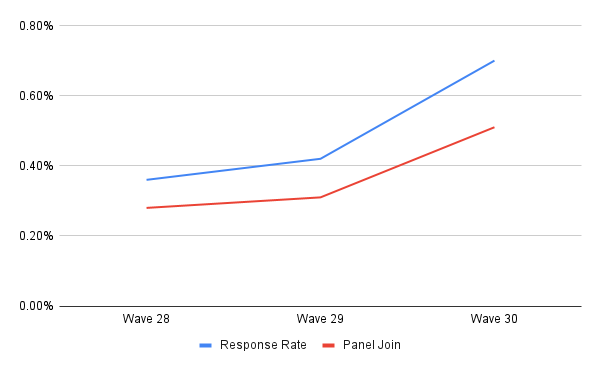
The central question, of course, is whether this approach actually delivers. We evaluated the SMS-to-prepaid recruitment strategy against four criteria: whether it reaches underrepresented subgroups, whether these SMS-to-prepaid recruits respond to the first panel survey at comparable rates to mail-based recruited panelists, whether they continue responding over time, and whether their data quality is comparable to mail-based recruits.
On the first question, the answer is clearly yes. Panelists recruited via SMS to prepaid numbers are substantially more likely than recruits by mail to be Black, Hispanic, younger, lower-income , unmarried, and renters. They are also more likely to report not having voted in 2024. These differences persist through the panel-joining stage, meaning the demographic benefits are not lost between survey completion and panel enrollment.
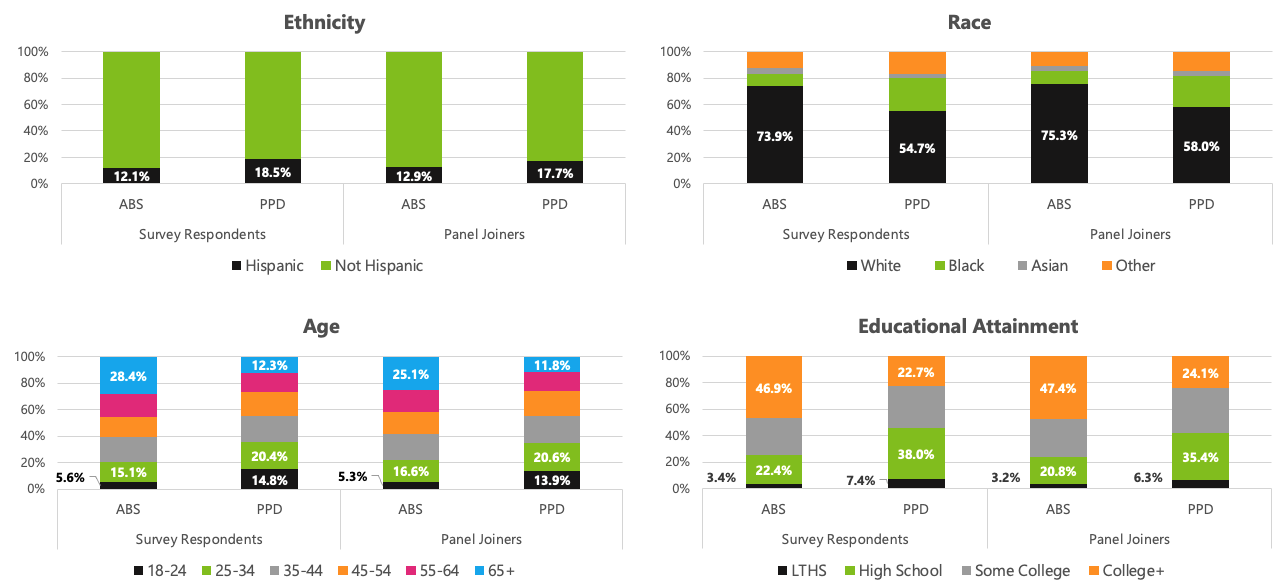
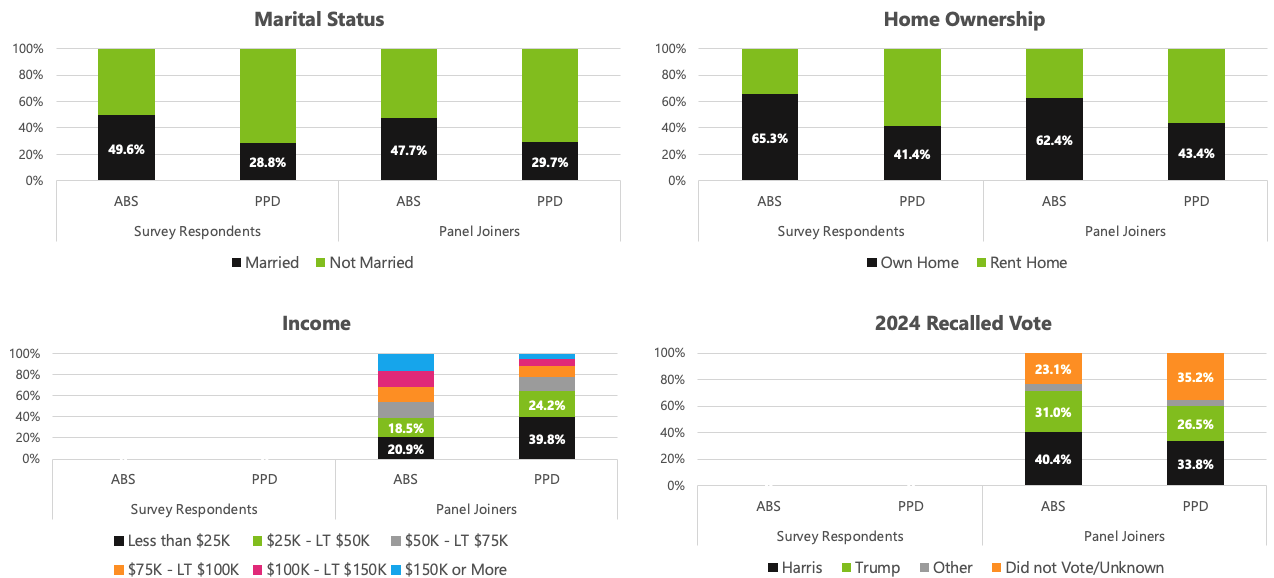
It is worth noting where the prepaid frame did not help. Prepaid cell recruits were not more civically disengaged than mail-based recruits (civic engagement was roughly equal across frames), did not have lower internet usage (prepaid cell recruits actually reported higher internet frequency), and were not more Republican. If anything, prepaid cell recruits skewed slightly more Democratic, which is consistent with the demographic profile of the prepaid phone population.
On the second question, whether prepaid cell recruits respond to the first panel survey at similar rates, the picture is more nuanced. Specifically, the percentage of text-to-prepaid cell recruits responding to the 1st survey was 8 percent lower in relative terms than the mail-based recruitment from the address-based sample.These differences persisted even after controlling for demographics in a regression. The remaining difference may reflect the change in contact mode: recruits were initially engaged via text message, but their first panel survey invitation likely arrived by email, which may reflect differences in preferences about contact modes.
The third question, whether prepaid cell panelists recruited by text message continue to participate over time, reveals a similar pattern. The average ongoing survey response rate for prepaid cell panelists was about 21% lower in relative terms than mail-based recruits from the address-based sample. However, when the analysis accounts for whether a panelist completed that critical first survey, the gap narrows considerably. Among those who completed the first survey, mail-based ABS samples and prepaid cell panelists recruited by text messages responded at very similar rates, within 2 percentage points. The first survey completion is by far the strongest predictor of ongoing participation, after controlling for first survey completion and demographics). In other words, the key to retaining prepaid cell panelists appears to be getting them through that first survey, a challenge that is both real and, we believe, addressable through future experimentation.
Finally, we examined data quality. Text-messages recruits to prepaid cellphone lists demonstrated comparable performance to mail-based ABS recruits. Quality control failure rates were low across the board (less than 2% on average), and the difference was not statistically significant.
Taken together, these results suggest that SMS outreach to prepaid cell phone numbers is a viable and valuable supplement to mail-based panel recruitment. This method reaches populations that mail recruitment consistently underrepresents, including younger, lower-income, non-white, and less politically engaged adults. The panelists it recruits provide data of similarly high quality. The primary challenge is that prepaid cell recruits are somewhat less likely to complete their first panel survey and, partly as a consequence, have slightly lower ongoing response rates. But even with this somewhat lower response rate, a meaningful proportion of this hard-to-reach group of panelists do continue to respond as panelists. And the strong relationship between first-survey completion and long-term retention suggests that improving the initial engagement experience around the first survey invitation (using text message rather than email, for example) could substantially close this gap.